
Waukesha Previous Residents by Era
A Waukesha address leaves different records at different times. Current parcel data gives the best starting identity. Recorded deeds then carry the same land backward, while assessment rolls, directories, census schedules, and maps help distinguish title from day-to-day occupancy. The strongest result comes from overlap: a deed names an owner, a directory places a listed householder, and a map confirms that the same building or lot existed.
| Source | Verified span | Custodian | Evidence |
|---|---|---|---|
| Public Access deed index | Fully indexed from 1994 | Waukesha County Register of Deeds | Transfers, parties, dates, legal description |
| Tract index and older images | Index 1848-1994; images reach early 1800s | Register of Deeds | Older land postings and recorded instruments |
| City directories | 1858 and 1890-present, completeness unstated | WCHSM and Waukesha Public Library | Listed household, address, work, spouse notation |
| City assessment rolls | 1896-1940, 1950, 1960, 1970 | WCHSM | Selected-year owners and values |
| Sanborn maps | 1884-1929; 1929 updated to 1949 | Wisconsin Historical Society | Footprint, material, use, stories, lot context |
| Census and obituary files | Varied local series | WCHSM and library | Households, life events, death and kin |
For a late twentieth-century question, start online. For an older house, expect a handoff to the tract books, research center, library, or state archives. Exact years matter because the local directory and assessment holdings are not described as complete runs.
Walk Back Waukesha Deeds
The deed chain is the backbone for previous residents who owned the property. First identify the current parcel in Waukesha County Tax Listing or City GIS. Save its situs address, current owner, tax key, and legal description. Situs means the physical parcel address; it may differ from the owner's mailing address. The legal description is more durable than either address or tax key.
- Find the current owner's purchase instrument by the parcel's subdivision, lot and block, condominium unit, certified survey map, or metes-and-bounds description.
- Open the deed and record the grantor, grantee, date, instrument number, book and page, and matching legal description.
- Treat the grantor, the seller, as the next person to check as an earlier grantee. Confirm the land description before accepting the match.
- Repeat until the trail reaches the online index boundary. Then switch to the tract range, office terminal, microfilm, deed books, or archive holdings.
- Compare transfer dates with directories, tax rolls, permits, newspapers, and census years. A sale date is not automatically a move date.
- Grantor
- The party transferring an interest in land.
- Grantee
- The party receiving that interest.
- Chain of title
- The linked sequence of transfers for the same land.
- Legal description
- The lot, unit, survey, or written boundary description that identifies the land in recorded documents.
Remote users cannot search the Waukesha recorder by a person's name. Name searching remains available at the Register of Deeds office, which makes the counter important when the land description is missing.
Waukesha's 1994 Records Divide
Documents recorded on or after January 1, 1994 are fully indexed in Public Access. Earlier research is not a dead end. The browse-based online tract index spans 1848 through 1994, and some unindexed images reach into the early 1800s. A known instrument number, reel and image, or volume and page may retrieve material that a modern search does not expose.
The Waukesha online tract index is arranged by range and period. It is not one free-form box. A blank-looking tract page may mean no posting was made, while a “Forwarded to” note points to the next page. Search spelling variants when names become available at the office. Certified copies require an office visit or mail request; the public web application supplies ordinary viewing and purchase options.
The recorder's Public Access interface is visible below. Its legal-description workflow explains why a parcel and its land identity should be gathered before searching for previous residents.
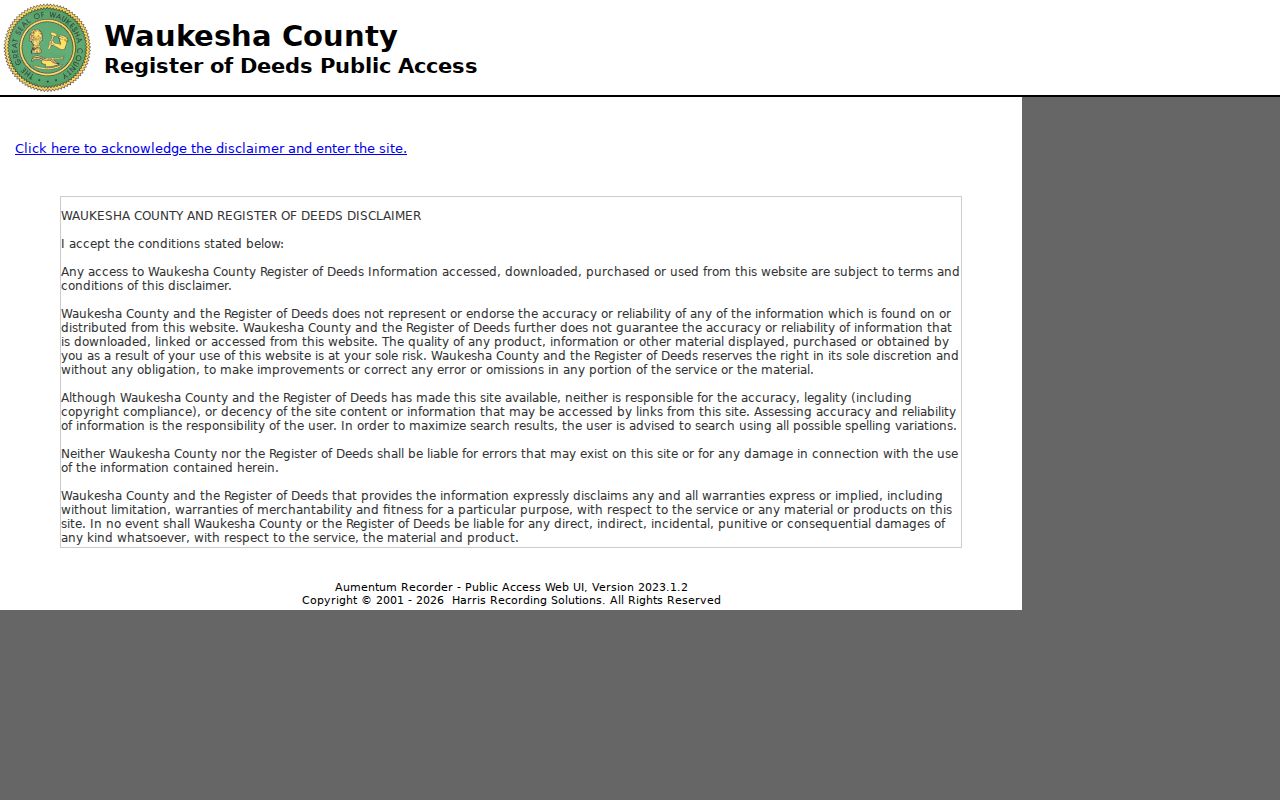
This screen is the modern doorway, while the tract volumes and office search carry the same address trail into earlier periods.
Waukesha House History Desks
The Waukesha Public Library at 321 Wisconsin Avenue is the practical first call for city-directory questions, licensed newspaper databases, HeritageHub, and expanded FamilySearch access inside the building. Adult Reference can be reached at 262-524-3682. Ask staff for the exact directory, reverse directory, telephone book, or microfilm available for the target year because a complete shelf inventory is not posted online.
The Huelsman Family Research Center at WCHSM works by appointment. It opens Wednesday mornings and Friday mornings and afternoons. Members use the collection without a session fee; listed rates are $20 per session for others, $5 for students, and $20 per hour for remote research. Its files include deeds, abstracts, patents, mortgages, plat maps, assessment rolls, obituaries, censuses, cemetery transcriptions, school records, naturalization records, and family papers.
See the Research Center's library and archive resources before requesting help.
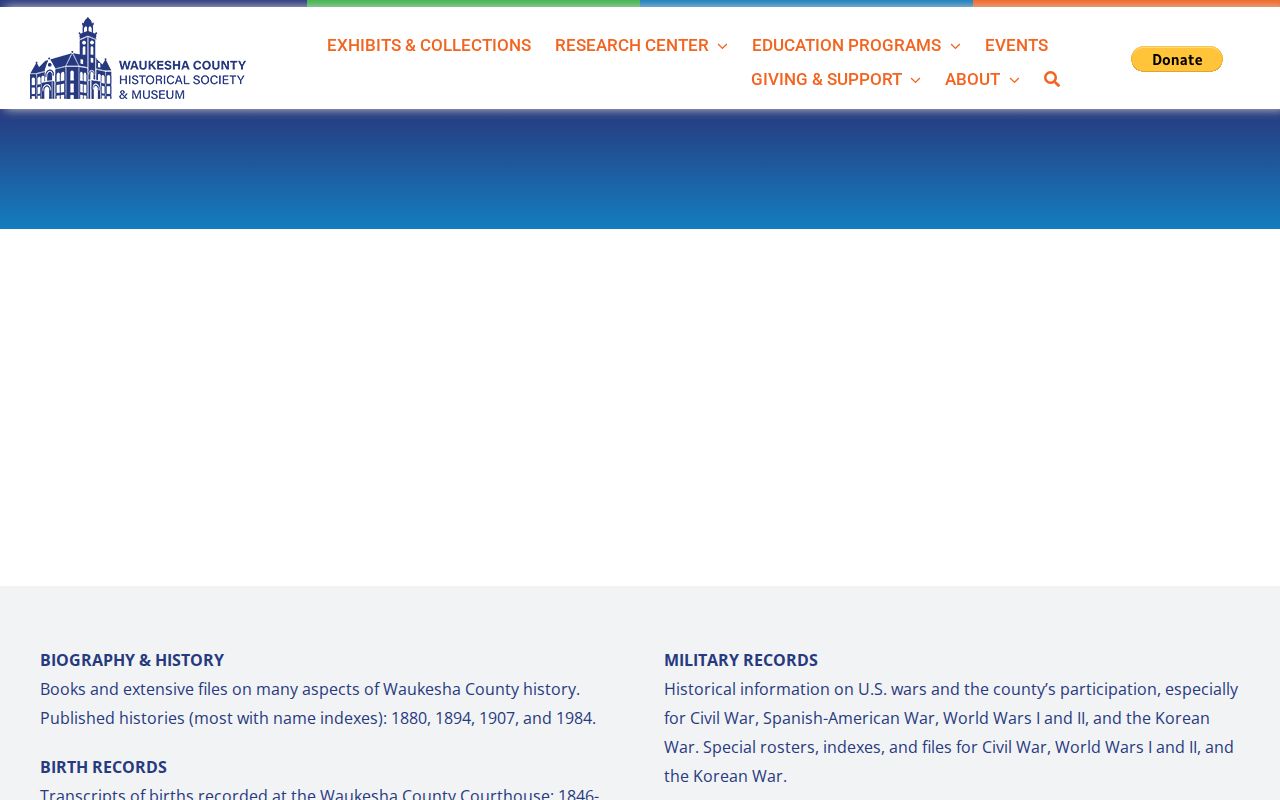
The breadth of that collection makes it the main offline bridge when online property systems stop or an address changed form.
Map Waukesha Previous Residents
Sanborn fire-insurance maps date the physical setting rather than the people. Waukesha sheets are documented for 1884, 1890, 1895, 1901, 1911, 1917, 1922, 1929, and a 1929 edition updated through 1949. They show a building's footprint, material, use, stories, and lot context. Pair a sheet with the legal description and an assessment roll, then ask whether the directory address belongs to the same structure.
WCHSM's City assessment rolls cover 1896-1940 plus 1950, 1960, and 1970, not every year. City Assessor files add material from the late 1920s through the 1950s. Historic plats run from 1859 forward. Together, these sources can carry a title clue across a street-name shift, subdivision change, or old tax key. No official source confirmed one citywide Waukesha renumbering date, so a researcher should never invent one.
One Waukesha House File
A Wisconsin Historical Society property file for 207 N. James Street shows how the pieces fit. It associates George Lyons with the property and Frank Buchan with 1906-1921, dates the building to about 1880, and notes work around 1910. Its citations lead to Waukesha city directories, Sanborn and plat maps, City tax rolls, permits, and newspaper material.
The example does not prove that a property file is a complete roll of previous residents. It demonstrates a better point: each claim can be tied to the source that supports it. A directory may place a listed contact, a permit may name an applicant or owner, and a deed records a transfer. Keeping those meanings separate prevents an attractive house story from becoming an unsupported household claim.
Close Waukesha Address Gaps
Permits, obituaries, and probate records often explain why a name disappears. City permit evidence may include the permit date, address, estimated cost, applicant, contractor, owner, and project details. A public search for all historic permits was not confirmed, so older files should be requested from City Community Development by address, date range, project, and name.
WCHSM holds obituary material from 1859 forward, while Waukesha Public Library provides the Waukesha Freeman from June 2000 to the current date, the Milwaukee Journal Sentinel from 1884 forward, and HeritageHub notices from 1704 forward. Probate files can identify heirs and an estate endpoint. WCCA and courthouse computers provide court access; older off-site files normally arrive within 72 hours and stay available for three business days.
Confirm Waukesha Past Households
Ownership is only half the search for previous residents. A listed householder, spouse notation, occupation, widow mark, or street address in a directory can place a person near a date, while a released census may show more of the household. WCHSM preserves territorial censuses, state census runs from 1855-1895, and selected federal schedules from 1850-1870 with township gaps.
Use a short sequence: select a confirmed directory year, compare the nearest available census, check the next directory, then test the name against assessment, deed, newspaper, and obituary evidence. Match the address, spouse, occupation, middle initial, neighbors, and date. The complete shelf questions belong on the Waukesha city directory page; the task here is linking each entry to one address over time.
Use records lawfully. House and family history are valid personal uses. Never publish a protected address or use a finding to watch, intimidate, or harass a living person.